Some data about the tank forces of the decisive WW2 front
(~75% of German ground and air forces were destroyed at Eastern front)
| Russian tank designers good knew theirs job,
they concentrated on the main things: powerfull gun, armor, and cross-country ability.
During the war, theirs suspension system was much better than in any German tanks
or other west countries tanks.
|
| F.W. von Mellenthin ,
German tank general.
|
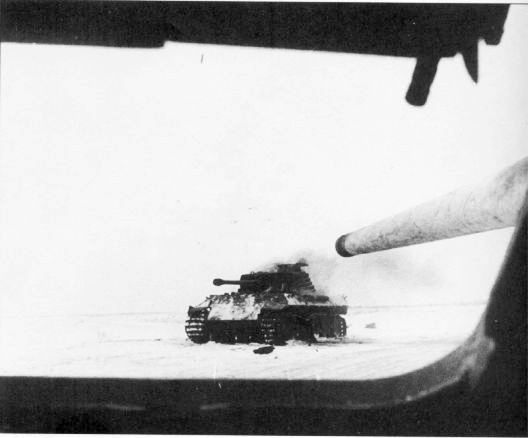
| | "Direct hit !" - a view from SU-85
|
|
|
|

The first tank aces
Victor A. Aminev (BA-10, 8th armoured brigade) destroyed 4 Japanese tanks on
4th Jule 1939. Till 7th July he destoyed 2 tanks more, and also 2 guns and 2 armoured cars.
2nd Polish tank batalion (7TP) clashed with the Germans on 5th September 1939.
The Poles killed 15 German tanks, and German AT guns killed 13 Polish tanks.
On of 7TP (name of commander is unknown) destroyed 5 Pz.I.
On 15th May 1940, the B-1bis heavy tank of 1/28 BCC (under command of
Sous-lieutenant Louis Latapie) killed 7 German tanks.
On 16th May 1940, the B-1bis heavy tank of 41BCC 3DCR (under command of capt.
Billotte) killed many German infantry, two PAK guns and 13 tanks (two PzKpfwIV and eleven PzKpfwIII) in Stonne town.
I have the incomlete list of Soviet tank aces;
also one American ace is known:
staff sergeant Lafayette G. Pool of 3rd tank division.
His unofficial score is 258 vehicles, the most of them are halftracks and lorries,
and 12 tanks and SPGs, also many different emplaces of guns.


The monster at the road.
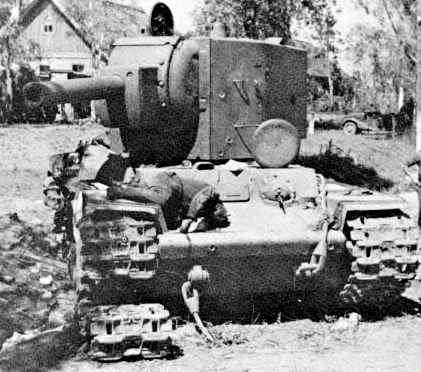
On 23-24 June 1941 a single KV-2 of 2nd tank division
conducted an armored road block in southern Lithuania (near Rassaynjay town),
holding up the German advance. The Germans found themself in a trouble
when they lost whole supply truck collumn. Numerious
attacks including a battery of 50mm anti-tank guns (which were destroyed at
500m distance), Flak 88 (the Soviets allowed to mount this gun
at 700m distance and then killed it) and an engineer
unit attack all failed to silence the Russian tank.
Artillery fire of 105mm howitzers achieved a hit to the track
and the KV was partially immobilised.
This heavy tank at the only road and surrounding swamps made German troops
supply (with ammo, fuel and food) and wounded soldiers evacuation impossible.
The Germans were forced to use such trick: 50(!) tanks immitated an attack,
so it became possible to set another 88mm flak, which
managed to eliminate the tank after two days it held up the advance
of the entire 6th Panzer Division.
The Stukas were not used beacause a commander not allowed an
operation "against one tank".
By the Germans' accounts, the crew could have
escaped easily several times before the final attack, but the heroes
always chooses own fate...
1 versus 43
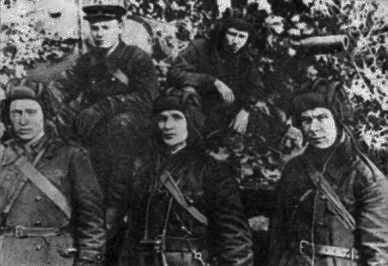
On 18 August 1941, an alone KV-1 (the number 864, the commander was lt.Kolobanov) was dug in
and camouflaged near Krasnogvardeysk town (Leningrad area). The tank had an order to defend
the road from Kinigsep. Four more KVs were ordered to defense two other roads.
All tanks got double ammoloads, 2/3 of rounds were armor piercing.
An offensive of 8th German panzer division was expected.
Kolobanaov's KV had great hidden position in the woods on the hill, the
crossroad located down there between swamps.
In the next day German motorcycle recon troops, halftrack and one light track
passed by road. Five minutes later the expected big tank column appeared and
filled the road. The 1st Soviet round flamed the head tank, after two more shots
the 2nd tank was flamed too. Then Kolobanov opened fire on column's tail and flamed
the last tank: the Germans were locked. They even couldn't note Soviet tank and
opened no-target-fire. Tried to run, some tanks were immobilized in the swamp.
The chaos established on the road. Soviet tankers killed 22 German tanks
during 30 minutes. Then the KV was spotted by the Germans and they opened aimed fire.
In spite of impossibility of German tank guns to penetrate thick KV's armor,
knocking rounds made terrible working conditions for Soviet crew. One of German
rounds struck the turret ring and the KV was forced to leave its
trench and maneuver by whole hull for aim.
Then the Soviets noted two German towed guns appeared on the crossroad.
The first shell disabled one gun, but another gun managed to do one shot
and damaged KV's periscope. Than that gun was destroyed too.
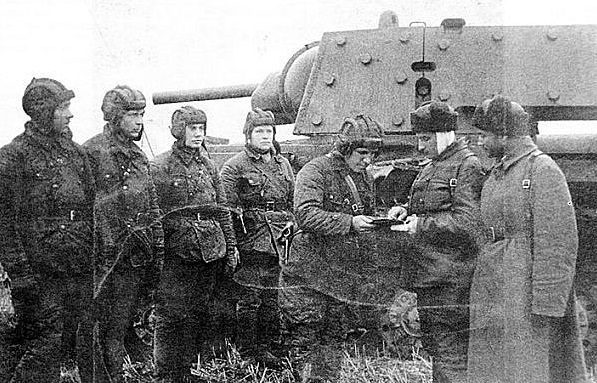
Also ammo was almost out, and Kolobanov got congratulations via the radio and an order to go
back. Already three another KVs were on the way to the battlefield.
There were destroyed 43 German tanks, 19 guns, 11 halftracks.
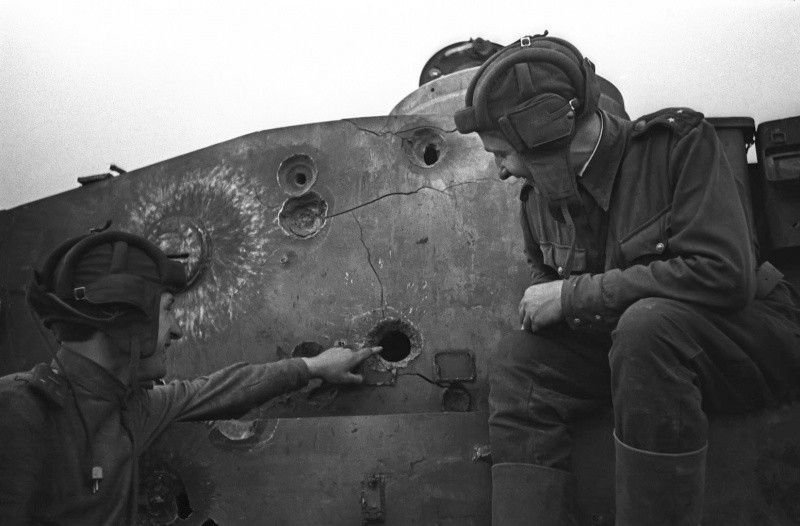
Kolobanov's tank got 135 hits, but no one penetration.
Kolobanov was awarded with the Order of Lenin, Usov (gunner) with the Order of the Red Banner.
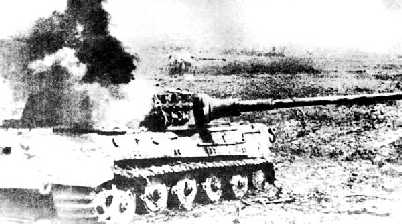
The PzKpfwVIH Tiger's debut
On 23 August 1942, first four PzKpfwVIH tanks arrived to sPzAbt502 unit
(Mga station near Leningrad) .
These tanks had a harmless long-range fire contact with Soviet troops near Sinjavino
village. Then the tanks tried to attack, but three of them were
immobilized because of mechanical breakdowns. The Germans managed to evacuate
the Tigers during nighttime, but these tanks were repaired only
in September 15.
Early morning of September 22, four Tigers and one PzKpfwIII started an
attack to Gaytolovo village. They were faced by arty fire and
the PzKpfwIII was flamed almost immediately. Then the command tank was hit,
(the engine was quit) and its crew left it. After that two more Tigers
were killed, and last one stopped in a swamp. So all of five tanks were destroyed.
At this time, an evacuation couldn't be performed. Two days after, the Germans
brought out all of the instruments and armament, and then exploded the tanks.
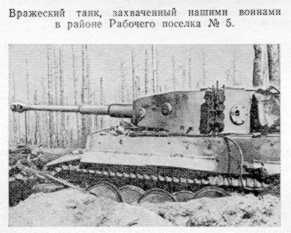
The Soviets managed to capture a Tiger on 17 January 1943, when they tried to
deblockade Leningrad.
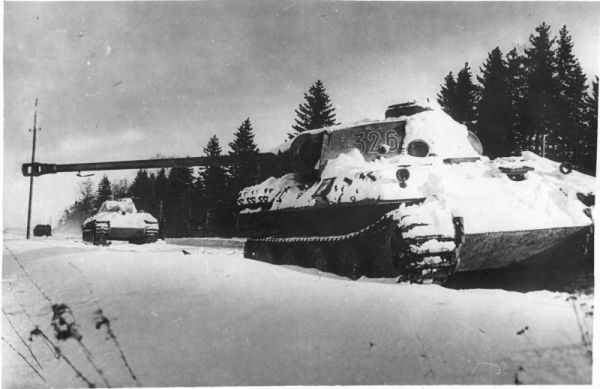
The PzKpfwVIB KingTiger's debut at Eastern front
In August 1944, alone Soviet T-34/85 supported by SMG platoon, held
defence near Ogledow village, Poland. Meanwhile, sPzAbt501 unit just got 45 brand
new heavy tanks PzKpfwVIB. During a 50km march 37 (!) of them were immobilized
due mechanical breakdowns. On 10 August, the rest of the KingTigers reached Ogledow.
Next morning three KingTigers started attack to a bridge over Vislula river.
Gds.lt. Oskin (the commander of the Soviet tank) spotted unfamous-looking German
tanks on a road. The T-34/85 was excellently camouflaged, so Oskin decided to
wait a little. When the Germans reached a distance less than 200m, the Soviets
opened fire by APDS and regular AP rounds hoping to penetrate the side armor.
One of the KingTigers was flamed by tree hits, and
the Germans couldn't even spot where the fire came from. Another PzKpfwVIB
took three hits, but its thick armor was not penetrated. 4th round impacted
precisely under the turret, and the victim exploded.

The last KingTiger tried to run, but it was impossible. The T-34 fired a smoke
ammo, then did maneuver to intercept and killed him.
The result: 11 men of German crews were killed, 1 captured by Soviet SMG platoon;
two KingTigers were totally destroyed, and last one was repaired and moved
to Soviet polygon Kubinka (where it was learned).
Germans reported about "strong Russian anti-tank defense, impossible to penetrate it by existing forces".
Lately, 3 more PzKpfwVIB were captured in Ogledow.

Guards lt. Oskin was awarded with the Gold Star of the Hero of Soviet Union,
the other crew members (incl. the excellent gunner serg. Abubakir Merkhaydarov
and the loader A. Khalyshev) were awarded with an orders.
The photos presented by Alexander Abramov, John Fluker and Diego Zampini.
||| War is Over Main page ||| Links |||
Email Me ||| About me ||| Support this site |||
Games: ||| War Birds ||| Red Baron
||| Aces High ||| other Sims
||| Close Combat ||| other Strategy |||
History of Aviation: ||| WW1 ||| Spain
||| China ||| Poland ||| WW2 |||
Korea ||| Vietnam
||| WW3 |||
Ground Forces: ||| WW1 tanks ||| WW1 Arm.Cars ||| WW1 Arm.Trains |||
WW2 Infantry ||| WW2 Artillery |||
infantry in Chechnya |||
main URL